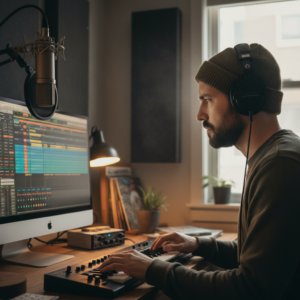
The Endless Upgrade Cycle: Are You Blaming Your Tools?
It’s a familiar story for many aspiring producers and artists. You’ve just finished a track, listening back intently, but something feels off. It lacks that polished, professional sheen you hear in your favorite songs. Immediately, a thought creeps in: “If only I had better monitors,” or “This compressor plugin just isn’t cutting it,” or “My microphone must be holding me back.” This cycle of attributing perceived shortcomings to your equipment, rather than your technique, is what we call the ‘Gear Myth’—and it’s one of the biggest hurdles holding back emerging talent.
At Musiketo, we believe in empowering creators through knowledge. While it’s tempting to think a new, expensive piece of hardware or software is the magic bullet to sonic perfection, the truth is far more nuanced. For most independent artists and producers, the bottleneck isn’t the quality of their entry-level or even stock gear; it’s often a fundamental misunderstanding or lack of mastery over basic production principles. Let’s unpack why prioritizing skill over spending will consistently yield superior results.
Why Your Starter Setup Isn’t the Real Limiter
Think about it: many classic recordings were made with equipment that would be considered primitive by today’s standards. While technology has undeniably advanced, the core principles of great sound engineering—gain staging, equalization, compression, reverb, and effective arrangement—have remained constant. Modern, affordable digital audio workstations (DAWs) and their bundled plugins are incredibly powerful, often exceeding the capabilities of analog studios from just a few decades ago.
The Power of Stock Plugins
Many DAWs, like Ableton Live, Logic Pro, FL Studio, and Reaper, come bundled with a comprehensive suite of high-quality effects. Their stock EQs, compressors, reverbs, and delays are perfectly capable of achieving professional results when used correctly. The difference between these and their expensive third-party counterparts often lies in subtle workflow enhancements or niche features, not a fundamental inability to perform the core task. Learning to master your DAW’s native tools will build a stronger foundation than constantly chasing the latest trendy plugin.
The Unsung Hero: Your Room Acoustics
Before you even consider upgrading your speakers, consider the environment they’re in. An untreated room, full of reflections, standing waves, and uneven frequency responses, can make even the most expensive monitors sound inaccurate. Investing time and a modest budget in acoustic treatment (even DIY solutions like bass traps and absorption panels) will have a far more profound impact on your ability to hear and make critical mixing decisions than simply buying ‘better’ speakers. You can only mix what you can accurately hear.
Shifting Focus: Mastering the Fundamentals
Instead of browsing gear forums, dedicate your energy to these core areas:
1. Deep Dive into Gain Staging
Proper gain staging is the bedrock of a good mix. It’s about managing the signal levels at every stage of your audio chain to ensure a healthy signal-to-noise ratio, avoid clipping, and provide optimal input for your plugins. A mix that starts with poor gain staging will forever be fighting itself, no matter how many fancy plugins you throw at it. Focus on getting good levels from your recording source, into your DAW, and through each effect chain.
2. Understand EQ and Compression Intimately
These two tools are the bread and butter of mixing. Rather than just blindly applying presets, take the time to understand *what* they do and *why* you’re using them. Learn about different EQ types (parametric, graphic, shelving), how to identify problematic frequencies, and how to use subtractive EQ effectively. For compression, grasp concepts like threshold, ratio, attack, release, and knee, and how they shape dynamics and tone. Experiment with how subtle changes affect the perception of an instrument.
3. Cultivate Critical Listening Skills
This is arguably the most important ‘skill’ you can develop. It involves actively analyzing commercial tracks, identifying individual elements, their placement in the stereo field, their dynamic range, and how they contribute to the overall sonic picture. Reference tracks are invaluable. A/B your mix constantly against professional productions in a similar genre to train your ears to identify imbalances and areas for improvement.
Common Pitfalls to Avoid
- The ‘Magic Plugin’ Hunt: Believing a specific new plugin will instantly fix all your mixing problems.
- Blaming the Tools: Attributing poor results solely to your equipment instead of seeking knowledge and practice.
- Over-Processing: Relying on extreme EQ and compression to fix fundamental issues that could be solved at the source or during arrangement.
- Ignoring Room Acoustics: Mixing in an untreated space without understanding its impact on sound perception.
Conclusion: Your Ears and Brain Are Your Best Tools
The journey to professional-sounding music isn’t paved with credit card receipts, but with dedication, practice, and a deep understanding of audio fundamentals. Your entry-level gear is far more capable than you probably realize. By shifting your focus from acquiring new tools to mastering the ones you already possess, and by investing in your listening environment and education, you’ll unlock a level of sonic clarity and professionalism that no amount of expensive hardware can instantly provide.
Your Next Step: Choose one fundamental concept (e.g., gain staging or subtractive EQ) and dedicate your next five mixing sessions solely to practicing and understanding it deeply with your current tools.