Close your eyes and listen to your favorite track. Does the vocalist sound right in front of you, the drums spread wide, and a synth pad gently washing in from the background? That feeling of instruments existing in distinct places – a soundstage, if you will – isn’t magic. It’s the carefully crafted illusion of audio space, a powerful yet often overlooked element of music production. For curious listeners, understanding this enriches your experience. For emerging artists and producers, mastering it is key to making your music truly immersive.
?? Watch the video above to learn more!
Most of us listen in stereo, which traditionally implies a left-to-right spread. But modern mixing goes far beyond just panning. Producers manipulate sound to create a sense of depth (front-to-back), width (left-to-right), and even perceived height. This article will guide you through the techniques used to build these sonic environments and help you train your ears to hear the subtle artistry behind them.
The Anatomy of Audio Space: Width, Depth, and Height
Think of a live band on a stage. You can see where each instrument is positioned. In recorded music, these visual cues are gone, so producers must paint the picture with sound alone. This ‘painting’ is achieved by meticulously placing each sound within a three-dimensional sonic landscape.
Width: The Stereo Field
The most intuitive aspect of audio space is width. This is primarily controlled by panning – adjusting where a sound sits between your left and right speakers or headphones. While many core elements like kick drums and lead vocals often sit centrally, other instruments are spread out to create a sense of spaciousness and separation.
- Hard Panning: Placing a sound entirely to the left or right can create dramatic separation, often used for percussive elements or backing vocals.
- Subtle Panning: Most instruments are panned more subtly, creating a balanced and wide soundstage without feeling disconnected.
- Stereo Imaging: Techniques like stereo widening plugins or recording with specific microphone techniques (e.g., X/Y, Mid/Side) can make a single instrument or an entire mix feel much broader than simple panning alone.
Depth: The Front-to-Back Illusion
This is where things get really interesting. How does a producer make a guitar sound like it’s right in your face, while a string section feels like it’s further away? Several techniques contribute to this sense of depth:
- Reverb: This is the most potent tool for depth. Adding reverb simulates the reflection of sound in a physical space. A short, subtle reverb might place an instrument in a small room, while a long, lush reverb can make it sound like it’s in a vast concert hall, pushed further back in the mix.
- Delay: Short delays can create a sense of spaciousness, while longer, rhythmic delays can create echoes that place a sound within a larger environment.
- Volume: Louder sounds generally feel closer, while quieter sounds recede. Automated volume changes throughout a track can push elements forward or pull them back.
- EQ (Equalization): Rolling off high frequencies can make a sound seem more distant, as high frequencies tend to dissipate over distance. Conversely, boosting certain mid-range frequencies can bring an element forward.
Height: Perceived Verticality
While less overtly manipulated than width and depth, producers can create a perception of verticality. This is often achieved through:
- EQ: Sounds with more prominent high frequencies (e.g., cymbals, airy synth pads) can feel ‘higher’ in the mix, while those with a strong low-end presence (e.g., kick drum, bass guitar) often feel ‘lower’ or more grounded.
- Arrangement: Carefully layering instruments across the frequency spectrum, ensuring each has its own ‘space’ to occupy, contributes to this vertical separation.
How to Train Your Ears to Hear Space
Developing an ear for audio space is a journey, not a destination. It requires active, focused listening. Here’s how to start:
Start with Simple Arrangements: Pinpointing Elements
Choose tracks with fewer instruments. Listen to a solo acoustic guitar, a piano and vocal, or a sparse electronic track. Try to identify:
- Where is the vocal? Center? Slightly left?
- Are the drums wide or narrow? Can you distinguish the hi-hat from the snare by its position?
- Is there any background instrumentation? How far back does it sound?
Listen to the “Air” Around Instruments: Reverb Tails and Delays
Focus on how sounds decay. When a snare drum hits, does it stop abruptly, or do you hear a subtle tail of sound afterward? That’s reverb! Pay attention to its length and character. Can you hear distinct echoes? That’s delay. These cues are crucial for perceiving depth.
The Role of Dynamics: Breathing Life into the Mix
Dynamics refer to the loudness and softness of sounds. A mix with good dynamic range allows instruments to swell and recede, contributing to the sense of movement and space. Listen for moments when an instrument briefly comes to the forefront before settling back, or when the entire mix seems to expand and contract.
Compare Different Genres: From Sparse to Dense Soundscapes
Listen to a minimalist ambient track, then a dense orchestral piece, then a pop song, then a metal track. Notice how the producers use space differently to suit the genre. Ambient music often emphasizes vast, expansive spaces, while a pop track might prioritize clarity and presence for the vocals and beat.
Producer Techniques for Crafting Space
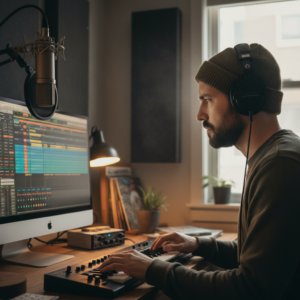
For aspiring producers, understanding these tools is essential:
- Reverb Plugins: Experiment with different types like Hall (large, long decay), Room (natural, short decay), Plate (bright, smooth), and Spring (twangy, retro). Each creates a distinct spatial impression.
- Delay Plugins: Use short slapback delays for a vintage, upfront sound, or longer, synchronized delays to create rhythmic depth and echo.
- EQ for Distance: Apply a gentle high-frequency rolloff to elements you want to push further back. Boost high-mids slightly on elements you want to sound present and close.
- Panning Laws: Understand that panning affects perceived loudness. Most DAWs have a ‘pan law’ that compensates for this, but awareness helps in making intentional choices.
- Arrangement: Sometimes, the best way to create space is to simply leave it. Don’t fill every frequency and every moment with sound. Allow instruments to breathe and occupy their own sonic real estate.
Common Mistakes in Creating or Perceiving Space
Even seasoned pros can stumble when it comes to spatial mixing, and new listeners might miss critical cues:
- Over-Reverberation: Drowning everything in too much reverb creates a muddy, indistinct mix where everything sounds far away and nothing stands out.
- Lack of Contrast: If every instrument is treated the same way spatially (e.g., everything panned centrally, same reverb), the mix will sound flat and two-dimensional.
- Ignoring Room Acoustics: For producers, not accounting for your monitoring environment’s acoustics can lead to mixes that sound great in your room but fall apart elsewhere.
- Passive Listening: For listeners, not actively focusing on where sounds originate can mean missing out on a significant part of the song’s artistry.
The illusion of space in music is a profound aspect of audio production, transforming a collection of sounds into an immersive experience. Whether you’re a listener seeking a deeper appreciation or a creator aiming for more impactful mixes, understanding how width, depth, and height are engineered opens up a new dimension of sound.
Your next step: Choose two or three of your favorite tracks. Listen specifically for the width of the drums, the depth of the vocal, and how different instruments are placed in the sonic landscape. Try to mentally map out where each sound sits in your imaginary three-dimensional space.